Why URL Structure Still Matters in SEO (2026 Update)
When most people think about ranking on Google, they immediately focus on keywords, backlinks, or content length. But one foundational element that quietly impacts rankings is often overlooked — URL structure.
Understanding SEO URL Structure Best Practices is no longer optional in 2026. It is a critical component of modern on-page SEO such as following a complete on-page SEO checklist 2026 that directly influences how search engines crawl, interpret, and rank your content.
A well-optimized URL does three powerful things at once:
- Helps search engines understand page context
- Improves user trust and click-through rates
- Supports better internal linking structure
A well-optimized URL structure supports better internal linking structure by following a strong internal linking strategy SEO 2026.
For example, compare these two URLs:
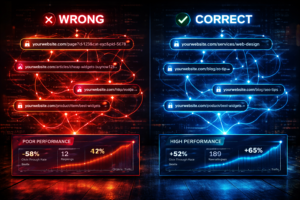
- ❌ example.com/page?id=12345
- ✅ example.com/seo-url-structure-best-practices
The second version clearly communicates intent — both to users and to Google. This is exactly why SEO URL Structure Best Practices play a major role in ranking success.

🔍 Google’s Perspective on URL Structure
Search engines like Google rely heavily on clean and readable URLs. According to official guidelines, URLs should be:
- Simple and easy to understand
- Keyword-relevant (but not stuffed)
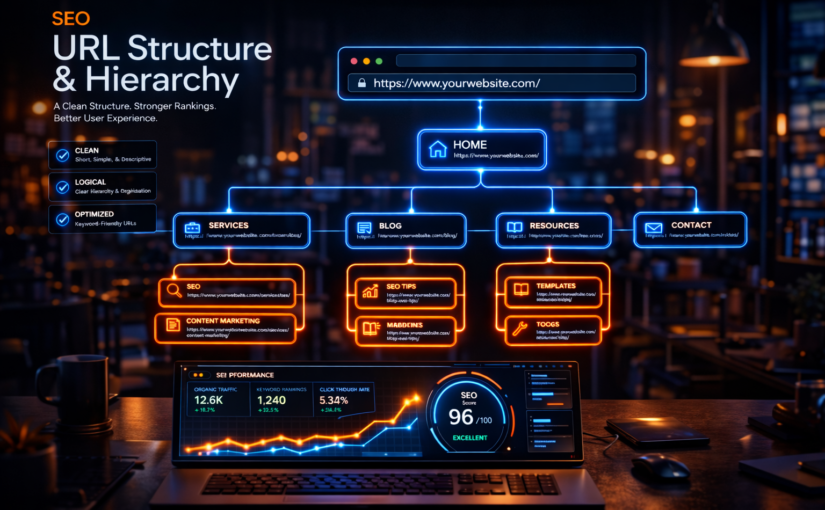
- Structured logically within the site hierarchy
A poor URL structure can confuse crawlers, dilute ranking signals, and even reduce indexing efficiency.
⚠️ Common Mistake Most Sites Make
Many websites still generate auto URLs filled with random numbers, dates, or unnecessary parameters. This leads to:
- Weak keyword relevance
- Poor user experience
- Lower ranking potential
By applying SEO URL Structure Best Practices, you create a strong technical foundation that supports every other SEO effort — from content optimization to internal linking.
💡 Pro Insight
Think of your URL as a mini headline. If it’s clear, concise, and keyword-focused, it becomes a ranking signal — not just a technical detail.
Anatomy of an SEO-Friendly URL (What Actually Works)
To properly apply SEO URL Structure Best Practices, you first need to understand what makes a URL search-engine friendly. Not all URLs are created equal — and small structural differences can significantly impact rankings.
An optimized URL is not just about inserting keywords. It’s about clarity, hierarchy, and usability.
🔑 Core Elements of a Perfect URL Structure
Here are the essential components every high-performing URL should include:
1. Short and Clean Format
Short URLs consistently perform better in search results. They are easier to read, remember, and share.
- ✅ example.com/seo-url-structure
- ❌ example.com/blog/2026/04/seo-url-structure-best-practices-guide
A clean URL aligns directly with SEO friendly URLs and improves crawl efficiency.
2. Primary Keyword Inclusion
Including your main keyword naturally in the URL helps search engines understand page intent.
For example:
- example.com/seo-url-structure-best-practices
This is a direct implementation of URL optimization SEO and reinforces topical relevance.
3. Logical Hierarchy
URLs should reflect your site structure. This improves both user navigation and indexing.
Example:
- example.com/on-page-seo/url-structure
This supports a clean URL structure and strengthens internal linking signals.
4. Hyphens Instead of Underscores
Always use hyphens (-) to separate words.
- ✅ seo-url-structure
- ❌ seo_url_structure
Google reads hyphens as spaces, making your website URL structure SEO more effective.
5. Avoid Unnecessary Words
Stop words like “and,” “the,” “of” should be minimized unless needed for clarity.
⚠️ What Happens If You Ignore This?
Ignoring proper structure can lead to:
- Confusing URLs for users
- Reduced crawl efficiency
- Weak keyword signals
A poorly structured URL can weaken your keyword signals if not optimized properly, just like improper keyword density in SEO can impact rankings.
That’s why implementing SEO URL Structure Best Practices correctly gives you a competitive edge — especially in competitive US search markets.
💡 Pro Insight
Every URL should answer one simple question:
👉 “What is this page about?”
If the answer isn’t obvious, your structure needs improvement.
For deeper insights, you can refer to the official Google Search Central URL structure guidelines to ensure your URLs follow best practices for crawling and indexing.

Powerful SEO URL Structure Best Practices (Core Strategy)
Now that you understand the fundamentals, let’s break down the 12 powerful techniques that define modern SEO URL Structure Best Practices in 2026. These are practical, proven, and aligned with Google’s latest ranking signals.
🚀 12 Best Practices to Follow
1. Keep URLs Short and Focused
Short URLs improve readability and ranking potential. Avoid unnecessary folders or long strings.
2. Place the Focus Keyword Early
Always position your main keyword near the beginning of the URL for stronger relevance signals.
3. Use Hyphens for Separation
Hyphens improve readability and align with SEO friendly URLs standards.
4. Avoid Dynamic Parameters
URLs with symbols like ?id=123 weaken clarity and should be avoided when possible.
5. Maintain a Consistent Structure
A uniform format across your site improves website URL structure SEO and crawlability.
6. Use Lowercase Letters Only
Mixed-case URLs can cause duplication issues. Always stick to lowercase.
7. Remove Stop Words When Possible
Words like “and,” “to,” “for” can be removed unless they improve clarity.
8. Avoid Keyword Stuffing
Overloading your URL with keywords can harm rankings. Keep it natural and clean — a key rule in URL optimization SEO.
9. Reflect Content Hierarchy
URLs should logically connect to your site structure, supporting a clean URL structure.
10. Use HTTPS Secure URLs
Security is a ranking factor. Always ensure your URLs begin with HTTPS.
11. Avoid Dates in URLs
Dates can make content look outdated and reduce long-term ranking potential.
12. Make URLs User-Friendly
If a human can easily read and understand your URL, you’re following SEO URL Structure Best Practices correctly.
⚠️ Critical Mistake to Avoid
Many beginners try to over-optimize URLs by adding too many keywords. This creates spammy structures and reduces trust.
💡 Pro Insight
Think of your URL as a ranking signal + UX element combined. When optimized correctly, it boosts both SEO and user engagement.
URL Structure Mistakes That Kill Rankings (Avoid These)
Even when websites try to follow SEO URL Structure Best Practices, small mistakes can silently damage rankings. These issues often go unnoticed but can weaken your entire SEO foundation.
Let’s break down the most common URL mistakes — and why they matter.
⚠️ 1. Using Long and Complicated URLs
Overly long URLs reduce readability and confuse both users and search engines.
- ❌ example.com/category/blog/2026/04/seo-url-structure-best-practices-guide-tips
- ✅ example.com/seo-url-structure-best-practices
Short URLs align with SEO friendly URLs and improve click-through rates.
⚠️ 2. Keyword Stuffing in URLs
Adding multiple variations of the same keyword is a major mistake.
- ❌ example.com/seo-url-seo-structure-best-seo-url
This violates URL optimization SEO principles and can look spammy to Google.
⚠️ 3. Using Auto-Generated URLs
Many CMS platforms create URLs like:
- example.com/?p=567
These lack meaning and weaken your website URL structure SEO signals.
⚠️ 4. Ignoring URL Hierarchy
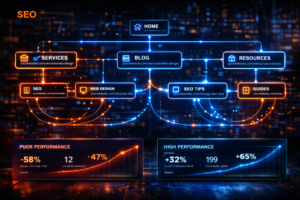
A poorly structured site leads to disconnected URLs. Without hierarchy, search engines struggle to understand relationships between pages.
This breaks the flow of a clean URL structure and impacts internal linking.
⚠️ 5. Changing URLs Without Redirects
Updating URLs without proper redirects (301) can result in:
- Lost rankings
- Broken links
- Traffic drops
This is one of the most damaging SEO mistakes.
⚠️ 6. Using Capital Letters or Special Characters
URLs should always be lowercase and avoid symbols like %, &, or _.
🚨 Why These Mistakes Matter
Ignoring these issues can lead to:
- Poor indexing
- Reduced authority signals
- Lower user trust
Even if your content is strong, bad URLs can hold your rankings back.
💡 Pro Insight
Fixing URL mistakes is often one of the fastest SEO wins. Small structural improvements can lead to noticeable ranking gains.
How URL Structure Impacts Rankings, CTR, and User Experience
Understanding SEO URL Structure Best Practices is not just about technical optimization — it directly affects how users interact with your website and how search engines rank your pages.
A well-structured URL acts as both a ranking signal and a conversion factor.
📈 1. Impact on Search Engine Rankings
Search engines use URLs to understand page context. When your URL includes relevant keywords and follows a logical format, it strengthens your SEO signals.
For example, using SEO friendly URLs helps Google quickly identify what your page is about, improving indexing accuracy.
Additionally, a strong website URL structure SEO setup ensures that authority flows correctly across your pages through internal linking.
👁️ 2. Influence on Click-Through Rate (CTR)
Users often scan URLs in search results before clicking. A clear and relevant URL builds trust.
Compare:
- ❌ example.com/page?id=9823
- ✅ example.com/url-optimization-seo-guide
The second option looks more trustworthy and clickable — a direct benefit of URL optimization SEO.
🧭 3. Better User Experience (UX)
A clean and readable URL improves navigation. Users can instantly understand where they are on your site.
This is where a clean URL structure becomes essential. It reduces confusion and increases engagement.
🔗 4. Strengthens Internal Linking
When your URLs follow a consistent pattern, internal links become more meaningful and structured. This supports your overall SEO architecture.
⚡ 5. Faster Crawling and Indexing
Search engine bots prefer simple and organized URLs. This improves crawl efficiency and ensures faster indexing of your pages.
💡 Pro Insight
Think of your URL as a trust signal. If it looks clean, relevant, and professional, users are more likely to click — and Google is more likely to rank it.
You can also review Google’s SEO starter guide to better understand how URL structure fits into overall on-page optimization.
Step-by-Step Guide to Creating SEO-Friendly URLs (Practical Implementation)
Now that you understand the theory behind SEO URL Structure Best Practices, let’s turn it into a practical, repeatable process you can apply to every page on your site.
Along with URL optimization, improving your on-page elements using a complete meta tags optimization guide 2026 can further boost your rankings.
Follow this step-by-step framework to create optimized URLs that rank and convert.
🛠️ Step 1: Define the Page Intent
Before creating a URL, clearly identify what the page is about.
Ask:
- What is the main topic?
- What keyword represents this page best?
This ensures alignment with SEO friendly URLs and prevents confusion.
🛠️ Step 2: Choose the Primary Keyword
Select one clear keyword that defines the page. Avoid mixing multiple variations.
Example:
- seo-url-structure-best-practices
This strengthens your URL optimization SEO strategy.
🛠️ Step 3: Keep It Short and Focused
Trim unnecessary words while keeping meaning intact.
- ❌ /complete-guide-to-seo-url-structure-best-practices-2026
- ✅ /seo-url-structure-best-practices
A shorter format supports a clean URL structure and improves readability.
🛠️ Step 4: Use Hyphens and Lowercase
Always separate words with hyphens and avoid uppercase letters.
🛠️ Step 5: Match Your Site Hierarchy
Ensure your URL fits logically within your site structure.
Example:
- /on-page-seo/seo-url-structure
This enhances website URL structure SEO and internal linking.
🛠️ Step 6: Avoid Dates and Dynamic Elements
Keep URLs evergreen by removing dates and parameters like ?id=.
🛠️ Step 7: Final Review Before Publishing
Before publishing, check:
- Is it readable?
- Does it reflect the topic clearly?
- Is it aligned with SEO URL Structure Best Practices?
💡 Pro Insight
Create a consistent URL pattern across your entire website. Consistency builds authority and improves crawl efficiency over time.
Final Checklist + Future-Proof URL Strategy (2026 & Beyond)
To fully implement SEO URL Structure Best Practices, you need a repeatable system that ensures every URL on your site meets high SEO standards — today and in the future.
This final checklist will help you maintain consistency, avoid errors, and scale your SEO strategy effectively.
✅ Ultimate SEO URL Checklist
Before publishing any page, confirm:
- ✔️ URL is short and readable
- ✔️ Focus keyword is included naturally
- ✔️ No keyword stuffing
- ✔️ Uses hyphens (not underscores)
- ✔️ All letters are lowercase
- ✔️ No unnecessary words or stop words
- ✔️ Matches site hierarchy
- ✔️ No dynamic parameters or random numbers
Following this checklist ensures your URLs align with SEO friendly URLs and modern ranking signals.
🔮 Future-Proofing Your URL Strategy
SEO continues to evolve, but one thing remains constant — simplicity wins.
To stay ahead:
- Focus on URL optimization SEO with clarity over complexity
- Maintain a consistent structure across all pages
- Regularly audit URLs for errors or outdated formats
- Avoid frequent URL changes unless absolutely necessary
A stable and optimized website URL structure SEO setup builds long-term authority and trust.
⚠️ Long-Term Mistake to Avoid
Constantly changing URLs can damage your rankings and break internal links. If changes are required, always use proper redirects.
💡 Final Pro Insight
Your URL is more than a technical element — it’s a ranking asset. When aligned with SEO URL Structure Best Practices, it supports every part of your SEO strategy, from content to internal linking.
🏁 Conclusion
By applying these 12 powerful techniques, you create a strong foundation for higher rankings, better user experience, and long-term SEO success.